
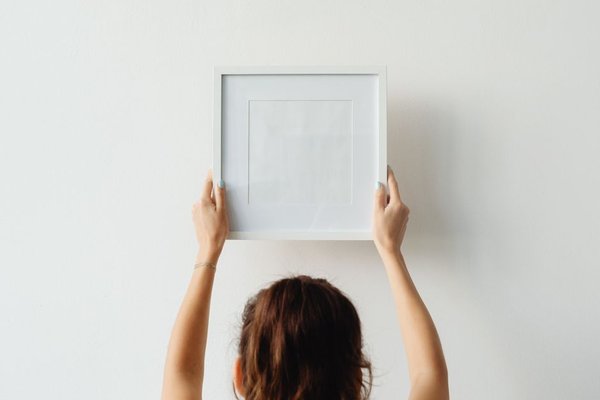
Most wall-art mistakes are not about the artwork itself; they are about a frame sitting a few inches too high. That small shift can make a room feel disconnected even when the furniture and scale are otherwise right. The simplest starting point is the 57-inch rule: place the visual centre of the artwork about 57 inches from the floor. That is roughly 145 cm, close to comfortable standing eye level.
It gives you a consistent reference point. From there, adjust for sofas, beds, consoles, gallery walls, unusually large pieces, and the way the room is actually used.
What the 57-inch rule really means
The 57-inch rule refers to the centre of the artwork, not the top of the frame and not the nail. If a framed piece is 30 inches tall, its centre is 15 inches from either edge. On a clear wall, aim to position that centre at about 57 inches from the floor.
This works especially well in hallways, entryways, dining rooms, and open wall areas where the art is not tied to furniture. Treat 57 inches as a dependable starting point rather than an inflexible law.
How to calculate the hook height
Measure the frame before touching the wall. Start with your preferred centre height, add half the artwork’s total height, then subtract the distance from the top of the frame to the hanging point.
For example, imagine a frame that is 30 inches tall. Half its height is 15 inches. If the picture wire, pulled taut, reaches 3 inches below the top, calculate 57 + 15 – 3. The hook should sit about 69 inches from the floor. If the frame uses D-rings, measure those attachment points instead.
When to break the 57-inch rule
Hanging pictures above a sofa
When hanging pictures above sofa seating, the furniture should usually control the placement. A common starting point is to leave about 6 to 8 inches between the top of the sofa and the bottom edge of the artwork or arrangement. That keeps the two elements visually connected instead of making the picture appear to float toward the ceiling.
A small print can look lost above a wide sofa even when the art hanging height is technically correct. A single piece or grouped arrangement often looks balanced when it spans roughly two-thirds of the sofa’s width. Centre it over the sofa rather than automatically centring it on the wall.
Above a bed, console, or sideboard
The same relationship-first principle applies above a headboard, console, or sideboard. Rather than forcing the centre to exactly 57 inches, keep the artwork close enough to read as part of the furniture grouping. Around 6 to 10 inches of breathing room is a useful range, depending on the furniture height, frame size, lamps, and objects on the surface.
When the height seems right but the wall still feels empty, choosing wall art size is often the real issue rather than placement.
Rooms with high ceilings
High ceilings tempt people to move art upward simply because there is more wall available. Usually, that makes the artwork feel detached. Eye level and furniture relationships still matter. If a tall wall needs more visual weight, choose a larger piece, taller grouping, or gallery wall instead of raising a normal-sized frame far above the viewing zone.
Very large or unusual artwork
An oversized vertical piece may feel too low if its exact centre sits at 57 inches, while a long horizontal work may sit comfortably a little higher. Stand back and judge the composition as a whole. Picture hanging rules create consistency, but proportion should win when a strict measurement looks awkward.
How high should a gallery wall be?
Treat a gallery wall as one large artwork. Instead of measuring every frame to 57 inches, find the visual centre of the entire arrangement and place that around eye level. Keep spacing between frames consistent so the collection reads as one composition.
If the gallery wall sits above furniture, prioritise the relationship to that furniture. Lay the arrangement on the floor first or mark its overall footprint with removable tape. Gallery wall layout ideas can help you choose between a grid, a centred arrangement, or a looser grouping before making holes.
Room-by-room adjustments
In a living room, use the sofa or console as the anchor where one exists. In a hallway or entry, the standard eye-level approach usually works well because people view the art while standing and moving through the space.
Bedrooms often benefit from closer placement above the headboard, while dining-room art can sit a touch lower if it is mainly viewed while seated. On a staircase, follow the rising line of the stairs rather than keeping every frame on one horizontal level.
If you are starting with a completely empty surface, how to decorate a blank wall is worth considering before finalising the height. The wall may need one statement piece, a pair, or a broader arrangement rather than a single small frame.
Common mistakes that make art look too high
The most common error is choosing the nail position first and thinking about the frame second. Another is centring art on the wall when it should be centred on the sofa, bed, or console below it. People also tend to react to tall ceilings by raising art too far.
Before drilling, make a light pencil mark or use removable painter’s tape to show the proposed centre and bottom edge. Then step back to the doorway or main seating position. A quick preview often reveals more than repeated measuring.
Frequently asked questions
Is 57 inches always the correct art hanging height?
No. It is a reliable eye-level starting point for artwork on an open wall, but furniture, artwork size, room use, and viewing position can justify moving the piece higher or lower.
How high should art hang above a couch?
A good starting point is about 6 to 8 inches between the top of the sofa and the bottom of the artwork. The visual connection to the sofa usually matters more than forcing the centre to exactly 57 inches.
Do you measure 57 inches to the nail?
No. Measure 57 inches to the visual centre of the artwork. The nail or hook will normally sit higher, depending on frame height and the position of the wire or hanging hardware.
Should all pictures in a room be hung at the same height?
Not necessarily. On open walls, a consistent centre line creates cohesion. Above furniture or on staircases, the surrounding architecture and furniture should guide the placement.
A simple rule that works because it can bend
If you are unsure how high to hang wall art, begin with the centre at 57 inches from the floor, then look at what surrounds it. Over furniture, keep the artwork visually connected to the piece below. For gallery walls, measure the arrangement as one unit. For large or unusual artwork, trust proportion after establishing a sensible eye-level baseline. The goal is not to obey a number perfectly; it is to make the art feel as though it belongs exactly where you placed it.